

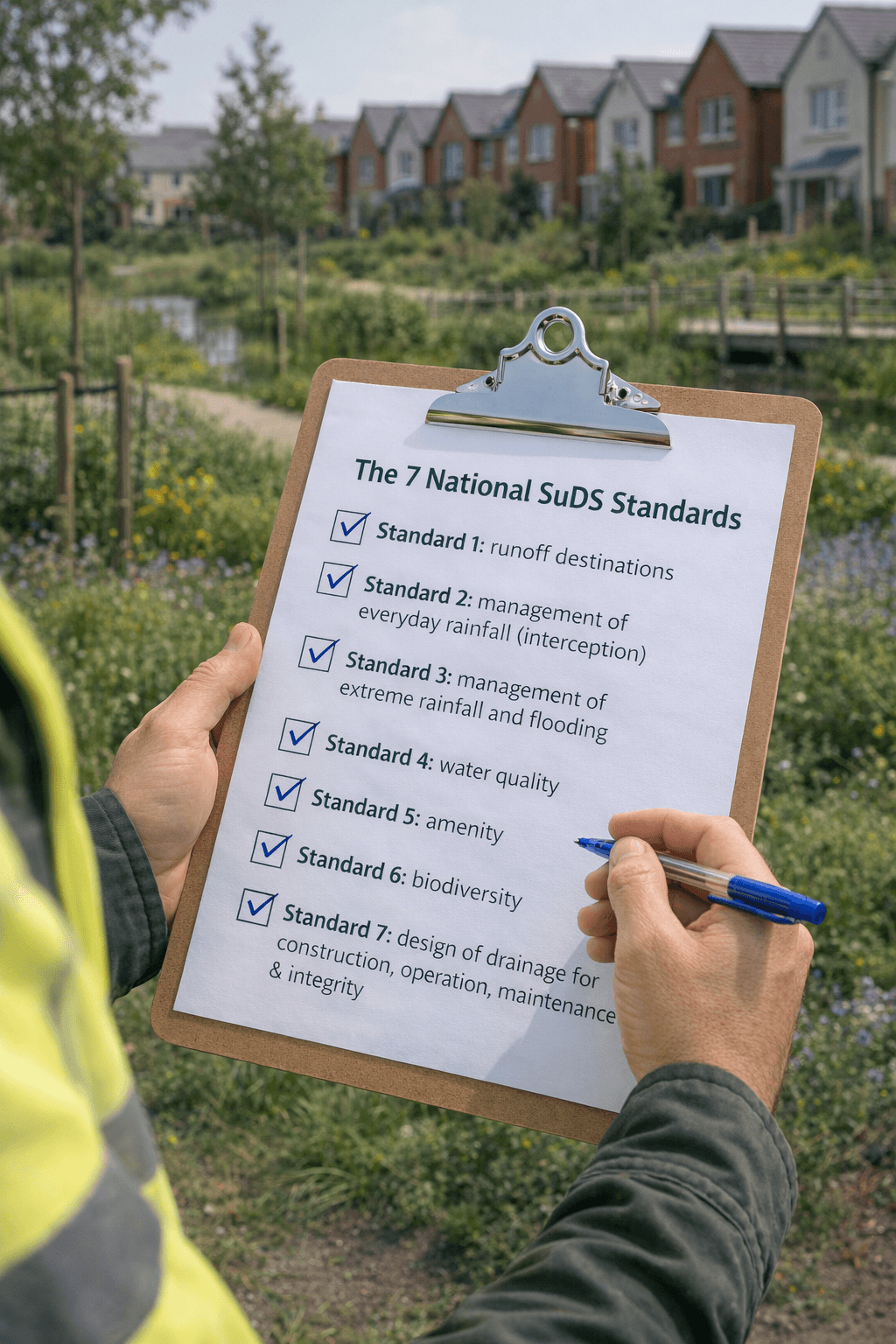
Over the past seven weeks, we’ve explored each of Defra’s National SuDS Standards and in that time we’ve explained what they mean in practice for developers, planners and design teams.
So, we thought we’d share a brief recap, look at the key takeaways from the last seven weeks and how RAB Consultants can help.
What are the Seven National SuDS Standards?
- Runoff Destinations
- Managing Everyday Rainfall (Interception)
- Managing Extreme Rainfall & Flooding
- Water Quality
- Amenity
- Biodiversity
- Construction, Operation, Maintenance, Decommissioning & Structural Integrity
What are the Key Learnings from the New National SuDS Standards?
As set out at the start of this series, the introduction of Defra’s National SuDS Standards has refocused attention on drainage as a fundamental component of planning approval. Across all seven standards, one consistent message emerges: successful SuDS design is not an add-on, it must be embedded into the development from the very beginning.
While each project will be considered on its own merits by local planning authorities, the expectations are clear. Proposals must demonstrate a logical, evidence-based approach to each of the seven standards, supported by robust site data and a well-coordinated design strategy. The level of detail can be proportionate to the scale and stage of development. But, the underlying principle remains the same: decisions must be justified, documented and aligned with the SuDS hierarchy and design philosophy.
In practice, this means identifying constraints early, understanding site conditions in detail and working collaboratively with an experienced drainage designer from the outset. Designs that attempt to retrofit SuDS into a fixed layout often face delay, objection, or costly redesign. By contrast, schemes that integrate SuDS from the start tend to move more smoothly through planning and deliver better long-term outcomes.
How RAB Consultants Can Help:
At RAB Consultants, we work alongside developers and design teams from the earliest stages of a project to shape drainage strategies that are both policy-compliant and commercially realistic.
Our approach focuses on early evidence gathering, identifying constraints, providing clear justification of design decisions and integrating with the wider development layout, helping to reduce planning risk and avoid unnecessary redesign.
Whether you are bringing forward a new site or reviewing an existing scheme, we can support you in navigating the National SuDS Standards with confidence.
Our Work in Practice:
On a recent residential development, early-stage assessments including infiltration testing and site constraint mapping allowed a drainage strategy to be aligned with the natural characteristics of the site. SuDS features were positioned to work with natural levels, preserving infiltration opportunities and eliminating the need for a sewer discharge by working with nature.
Because the drainage design evolved alongside the master planning process, the scheme was able to demonstrate clear compliance with the standards, avoiding late-stage redesign and allowing progression through planning without objection.
Thank you for following along over the last seven weeks. All of our articles will stay on our page so you can catch-up or check back whenever you want.
For more information on our sustainable drainage solutions and how we can help you, click here.