

Small Communities PFR Scheme Reaches Key Milestone
RAB Consultants were appointed to support delivery of a Property Flood Resilience (PFR) scheme across small Derbyshire communities identified as being at significant flood risk. The project forms part of a wider resilience initiative supporting homeowners who have previously experienced internal flooding or who are located within high-risk flood zones.
Working across Bakewell and Ambergate our role has covered the full lifecycle of delivery; from property-level flood risk assessments and tailored design, through installation oversight, to final verification. With works now complete at 32 properties, the scheme has progressed through structured Post-Installation Audits and controlled wet testing.
Why Wet Testing Matters
Flood-resistant doors and barriers are independently tested and certified under laboratory conditions. However, once installed within an existing property, performance is influenced by building geometry, threshold detailing, masonry interfaces, ground levels and workmanship.
Wet testing bridges the gap between certification and real-world performance by validating the installation as constructed, not simply the product specification.
It is important to emphasise that flood-resistant measures are not flood-proof. They are designed with an allowable leakage rate under controlled loading. The purpose of wet testing is therefore not to confirm “zero leakage,” but to:
- Verify performance consistency
- Identify abnormal or excessive leakage pathways
- Confirm structural integrity under hydraulic load
- Record achieved resistance at the intended design depth
All results are documented within a formal Wet Test Data Sheet and incorporated into the Post-Installation Flood Risk Report (PIFRR).
Constructing the Test Rig – A Controlled but Non-Intrusive Process
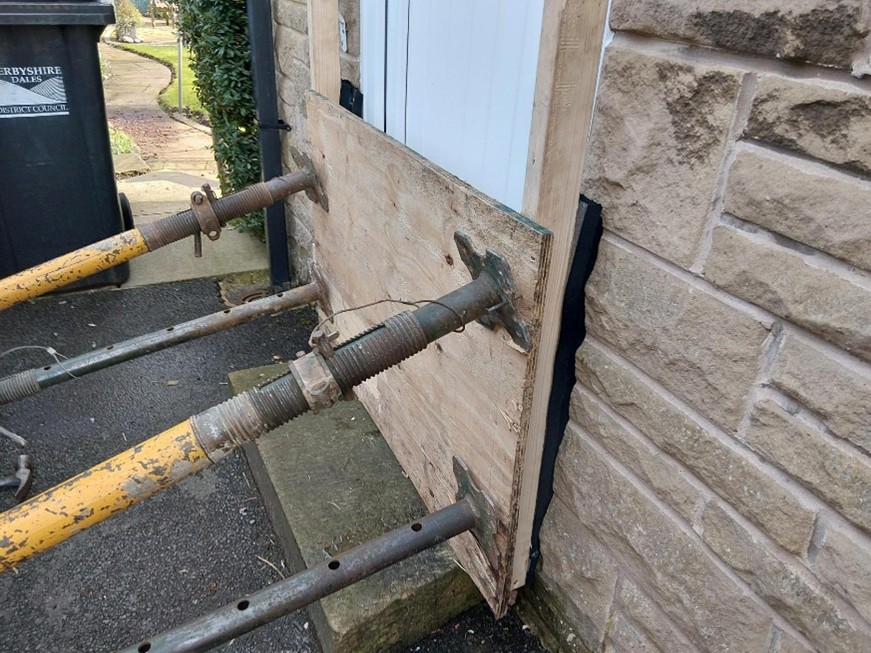
One of the most technically demanding aspects of wet testing is constructing a temporary rig capable of retaining water safely against a domestic property — without any permanent or intrusive fixing. Residential buildings are not designed to accommodate controlled hydrostatic loading at door thresholds. The test arrangement must therefore be:
- Entirely temporary
- Fully removable
- Installed without drilling, anchoring or mechanical fixing into the façade
- Implemented with no damage to the building fabric
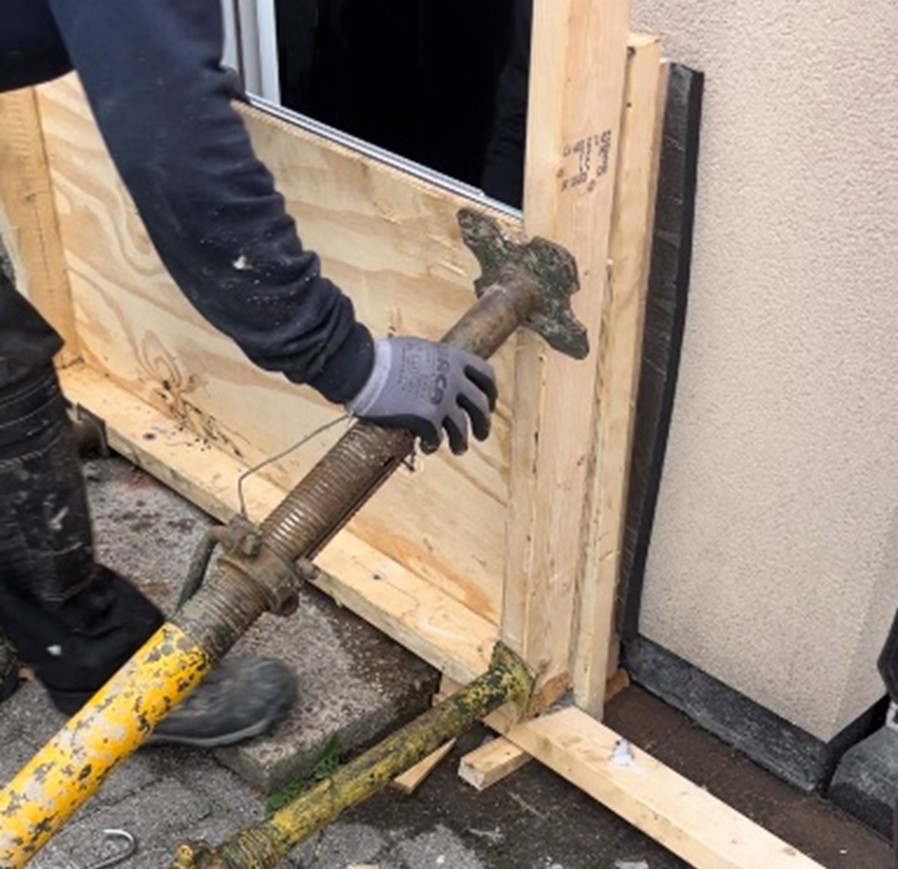
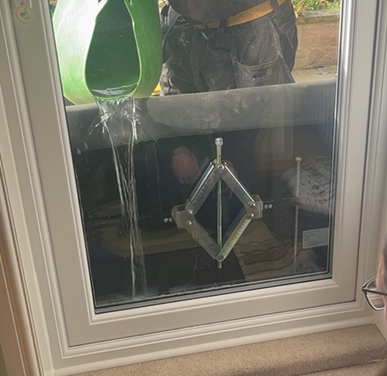
To achieve this, a bespoke test chamber is formed to retain water across the full installation — including frame, threshold and adjoining masonry — typically up to the designated design depth (often up to 600mm above external ground level, subject to structural considerations).
Because intrusive anchoring is not permitted, stability is achieved through carefully positioned compression props and bracing systems. These are mechanically adjusted to apply controlled opposing pressure, effectively counteracting the outward force generated by retained water. Protective interfaces are used to distribute load safely and avoid cosmetic marking.
This methodology allows the rig to “push” into position, creating a stable but entirely temporary structure capable of withstanding hydrostatic pressure for the required minimum five-minute retention period.
Site-Specific Engineering
Every property presents unique constraints that influence rig design and achievable test depth. Structural loading limits of thresholds and frames must be considered to avoid undue stress. Uneven paving, irregular masonry lines or minor façade variations can require adaptive sealing techniques to maintain water retention.
Where fragile or heritage masonry is present, load transfer through props must be carefully controlled. Access restrictions can also influence assembly methods. There is no standard configuration — each installation requires an individually considered approach. Wet testing therefore becomes as much an exercise in temporary structural engineering as it is in product verification.
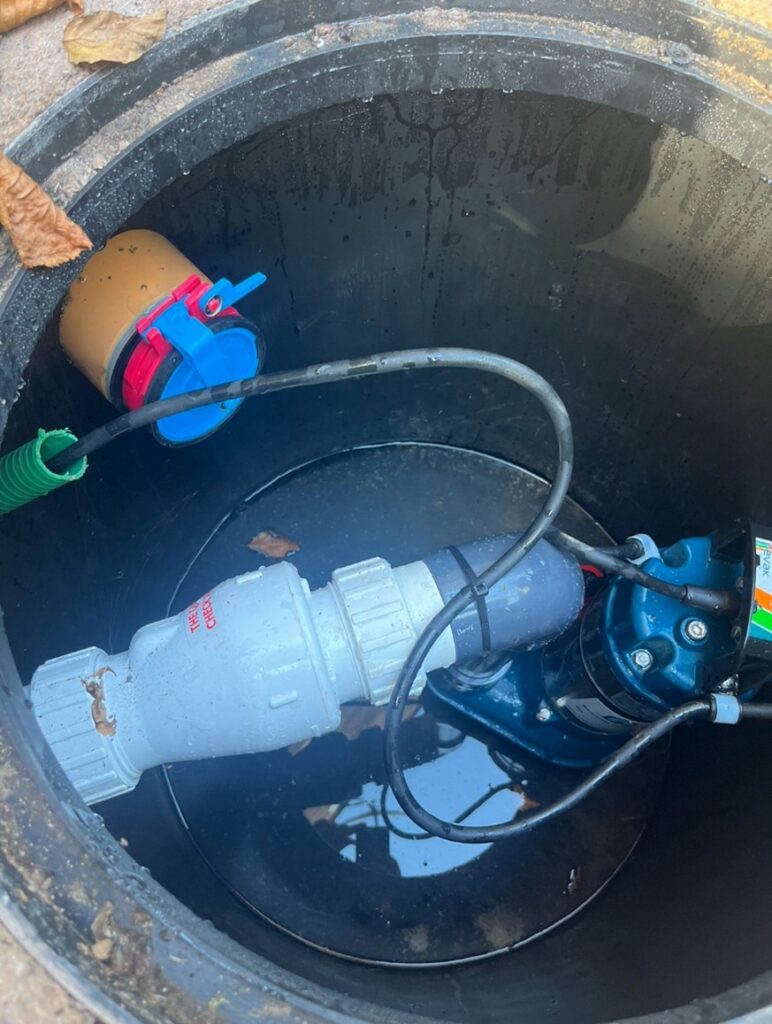
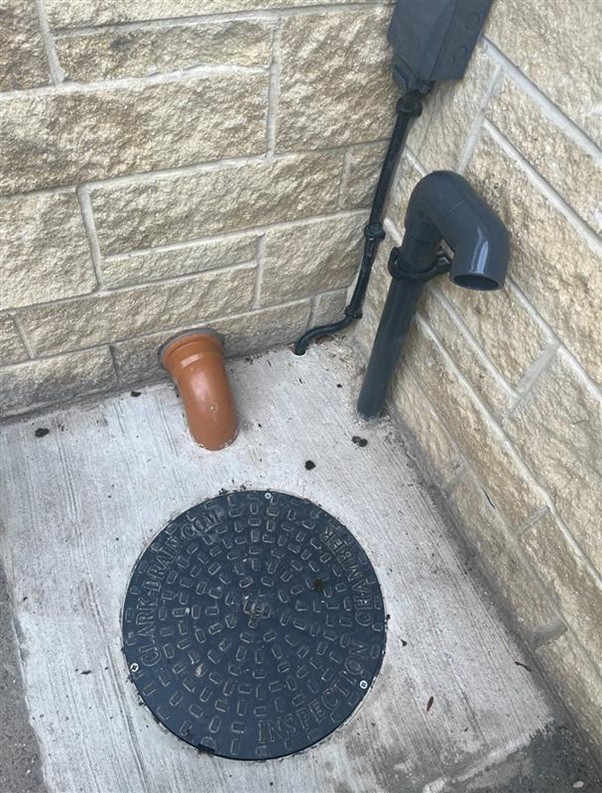
Sump pump installation
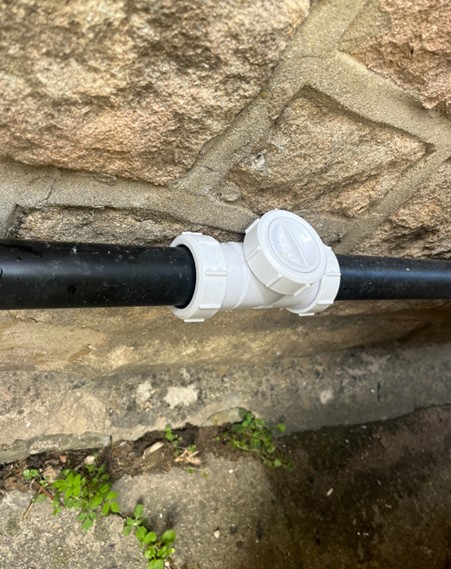
Non-return valve
Managing Allowable Leakage
As part of the scheme, puddle (skimmer) pumps are provided at protected doorways to actively manage shallow internal water accumulation resulting from allowable seepage through the measure or wider building fabric. This layered approach reflects best practice in Property Flood Resilience — slowing ingress, managing water effectively and reducing internal damage and recovery time.
Confidence Through Demonstration
Wet testing provides a valuable engagement opportunity for homeowners. Observing a flood door or barrier retaining a controlled head of water offers clear reassurance that:
- The installation has been completed correctly
- The measure performs in line with design expectations
- Allowable seepage is understood and manageable
- Supporting systems function as intended
Verified Resilience in Practice
Flood resilience is about measured performance, not assumptions. Through structured wet testing, careful monitoring and documented verification, this Derbyshire Small Communities scheme demonstrates that installed resistance measures have been tested under controlled conditions and formally recorded.
For 32 properties, the scheme represents a measurable and documented improvement in flood resistance and preparedness, with resilience strengthened, tested and formally verified.
Further information on the resilience and flood risk services that RAB provide is available on this website, or you can also get in touch by email (enquiries@rabconsultants.co.uk) or call our head office in Lichfield on 0330 223 6475.